
Why Kota Kulture Exists
A Digital Entrepreneur’s Vision for the Township Economy
My name is Thato Seaga. I am a digital entrepreneur. I’ve always loved two things deeply: sales and technology. The ability to build something from nothing — and the systems that allow it to scale — has always fascinated me.
But long before Kota Kulture became a website, it was a question that wouldn’t leave my mind.
Why is the township economy so powerful offline… yet almost invisible online?
If you walk through Soweto, Alexandra, Tembisa or Katlehong, you don’t see poverty. You see movement. You see trade. You see food businesses serving hundreds of customers a day. You see young entrepreneurs turning small spaces into economic engines. You see culture in motion.
Yet when you open Google, very little of that reality exists.
No structured listings.
No digital storefronts.
No unified archive.
No searchable ecosystem.
It felt like watching a gold mine operating in the dark.
And what operates in the dark cannot be measured.
What cannot be measured cannot be scaled.
And what cannot be scaled remains underestimated.
That realization is where Kota Kulture began.
The Structure Problem
The township economy is not small. It is simply unstructured.
Many kota shop owners and township entrepreneurs built businesses through instinct, hustle, and community loyalty. Technology was never the focus. In many cases, it wasn’t accessible. It was expensive. It was complicated. It felt unnecessary when word-of-mouth already worked.
Paper menus were enough.
Cash was enough.
WhatsApp was enough.
But while that system worked locally, the rest of the world moved into searchable ecosystems, digital payments, online reviews, and discoverability.
The result? A thriving economic network that search engines cannot see.
If Google cannot see it, investors cannot measure it.
If investors cannot measure it, institutions cannot value it.
And if institutions cannot value it, it remains locked out of larger opportunity.
Kota Kulture was built to introduce structure without removing soul.
Why Food Became the Entry Point
Food has always been the great connector.
It dissolves social barriers. It brings strangers to the same table. It carries memory, identity and pride. And in township culture, no food carries that energy more consistently than the kota.
In Soweto, it’s called a kota.
In the Vaal, you may hear skhambane.
In Pretoria, sphahlo.
Different names, same heartbeat.
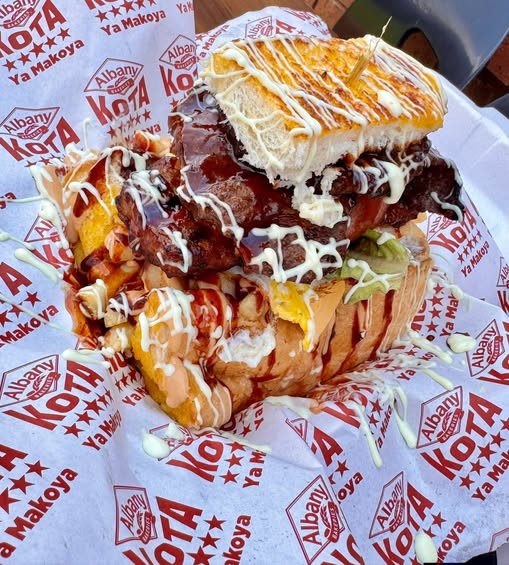
A hollowed quarter loaf filled with layers of flavour — slap chips, polony, Russians, egg, atchar, sauces — depending on region and creativity. Affordable. Filling. Portable. Customisable.
But more than ingredients, the kota represents something deeper. It represents the ingenuity that emerged during some of South Africa’s most difficult historical periods.
As apartheid forced Black South Africans into segregated townships and migrant labor systems disrupted family structures, informal food systems became survival tools. Over time, what began as necessity evolved into pride. The kota became a staple in schools, on street corners, at taxi ranks, and outside factories. It became fuel for workers. It became an after-school ritual. It became late-night culture.
Today, it is celebrated at festivals. It is debated passionately. It is innovated constantly.
The kota is not just food.
It is infrastructure.
If you want to digitise the township economy, you start with its strongest symbol.
From Cultural Icon to Digital Infrastructure
Kota Kulture was never about replacing what already exists. It was about strengthening it.
We asked a simple question:
What would happen if every kota vendor had a digital presence?
Not a complicated system.
Not something intimidating.
But something structured.
A digital menu instead of paper.
A searchable listing instead of invisibility.
A geolocated presence instead of guesswork.
A review system that builds trust beyond the street corner.
And beyond that — what if the diaspora could send a Kota Gift Card home instead of just sending money? What if township businesses could be discovered by tourists? What if corporate partners could access real data about township consumption patterns?
Suddenly, the informal economy begins to move toward measurable territory.
Not corporate.
But visible.
Respecting the Ecosystem
Kota Kulture understands hierarchy.
We did not invent the cultural movement around the kota. Festivals celebrating township food already exist and operate nationwide. They built audiences. They built platforms. They built celebration at scale.
What we are building is different.
They built the stage.
We are building the digital archive behind it.
That distinction matters. Because digitising culture requires humility. It requires listening before leading. It requires understanding that culture already belongs to the people who live it.
Our role is not to dominate the space.
Our role is to structure it.
Mapping the Kulture, One Kota at a Time
At its core, Kota Kulture exists because I believe the township economy deserves more than survival.
It deserves visibility.
It deserves infrastructure.
It deserves searchability.
It deserves to be measured on its own terms.
Technology should not erase township identity. It should amplify it.
The future of township entrepreneurship will not be built only on hustle. It will be built on systems. And those systems must be designed with cultural understanding at their center.
Kota Kulture is the beginning of that map.
And this is only the first chapter.
Leave a Comment