
The Origins of the Kota
How a Quarter Loaf Became the Heartbeat of Township Culture
Long before it became festival-worthy.
Long before it became Instagram content.
Long before it became a national symbol of township pride —
The kota was survival.
It did not arrive as a trend. It did not emerge from a restaurant kitchen. It was born in the streets and townships of Gauteng, shaped by economic hardship, migration, and resourcefulness during one of the most complex periods in South African history.
To understand the kota is to understand the township economy itself.
A Name From the Streets
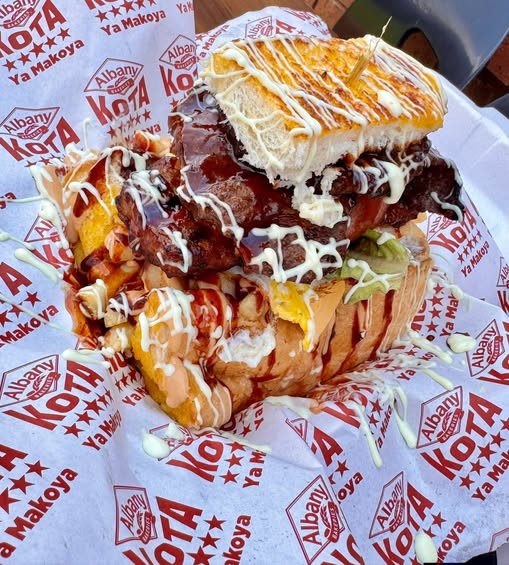
The word “kota” comes from township slang for “quarter” — referring to a quarter loaf of bread hollowed out and filled with ingredients.
In many township pronunciations, “quarter” softened into “kota.” The name stuck. It was practical. Direct. Unpretentious.
The quarter loaf became more than bread — it became a container. A vessel. A solution.
Inside that hollowed loaf, layers of affordable ingredients were added depending on what was available. Slap chips for bulk. Polony or Russians for protein. Egg for richness. Atchar and sauces for heat and flavor. It was filling, portable, and designed for people who did not have time for long sit-down meals.
Simple structure. Powerful impact.
The Apartheid-Era Context
The rise of the kota is closely linked to the growth of townships during apartheid. As Black South Africans were forcibly relocated under segregation policies, dense township communities formed around industrial and mining zones.
The migrant labor system reshaped family life. Many men worked long hours in mines and factories, often living in hostels far from their rural homes. Economic constraints were severe. Kitchen facilities were limited. Time was limited. Money was limited.
Food needed to be:
- Affordable
- Filling
- Easy to prepare
- Easy to carry
Informal traders stepped into that gap.
While precise historical documentation of the first kota is difficult to pinpoint, its emergence in Gauteng townships during the mid-to-late 20th century is widely associated with this period of urban concentration and informal trade growth.
The kota was not invented in a single moment. It evolved.
Evolution Through Creativity
Early versions are believed to have been simpler — bread filled with basic starches or mince. Over time, as access to different ingredients expanded and township economies became more active, the fillings diversified.
Slap chips became central — soft, vinegar-soaked fries that added both texture and substance. Processed meats like polony and Russians became common due to affordability and availability. Cheese, egg, chakalaka, and various sauces layered complexity.
Each township added its twist.
Each vendor developed their signature style.
In the Vaal, you might hear it called skhambane.
In Pretoria, sphahlo.
In other regions, variations of spatlo.
The name shifted, but the identity remained intact.
The kota adapted because the township adapted.
Cultural Crossroads
South African food culture is layered and influenced by multiple histories — African, Indian, European and more. Some food historians note conceptual similarities between the kota and the Durban-born bunny chow, another hollowed bread dish that emerged earlier in KwaZulu-Natal.
While the exact line of influence remains debated, what is clear is this:
South African street food evolved through proximity, migration, and shared ingenuity.
The kota became Gauteng’s signature contribution to that street food legacy.
From Survival to Symbol
By the 1980s and 1990s, the kota was firmly embedded in township daily life.
Students bought them after school.
Workers relied on them for lunch.
Taxi ranks sold them as quick fuel.
Vendors built loyal followings.
Over time, the kota moved from necessity to identity.
It became something people defended passionately. Everyone had a “best spot.” Everyone knew where the portions were bigger, where the sauce hit harder, where the bread was fresher.
And slowly, something powerful happened.
The kota stopped being labeled “poor man’s food.”
It became township pride.
Today, it is celebrated at large-scale events like the Jozi Kota Festival. It attracts corporate sponsors. It draws crowds beyond township borders. It has moved from corner shop to cultural stage.
That transformation matters.
The Kota as Economic Engine
Beyond taste and nostalgia, the kota represents something larger: informal entrepreneurship at scale.
Thousands of small food vendors across Gauteng and beyond rely on the kota as their primary business model. It is affordable to produce. It has predictable demand. It allows for creativity without requiring massive capital investment.
In many communities, a single kota shop supports:
- A household
- Extended family
- Local suppliers
- Young employees
Multiply that across townships nationwide, and you begin to see the invisible economic engine.
The kota is not just food.
It is micro-enterprise infrastructure.
Why This History Matters Today
Understanding the origins of the kota is not about romanticizing struggle.
It is about recognizing evolution.
What began in an era of constraint has grown into a symbol of resilience and innovation. It reflects the ability of township communities to build systems under pressure.
And that is exactly why it matters in the digital age.
If something has sustained communities for decades offline, imagine what happens when it becomes structured online.
The story of the kota is not finished.
It is simply entering a new chapter.
Leave a Comment